
Crude Oil Near $110: How US Policy on Russian Oil Could Impact Indian Stocks and the Global Economy
Explore how crude oil prices and US policy on Russian oil affect India's economy, rupee, inflation, oil marketing companies, aviation, paints, tyres and global markets.

IPOChacha Market Intelligence
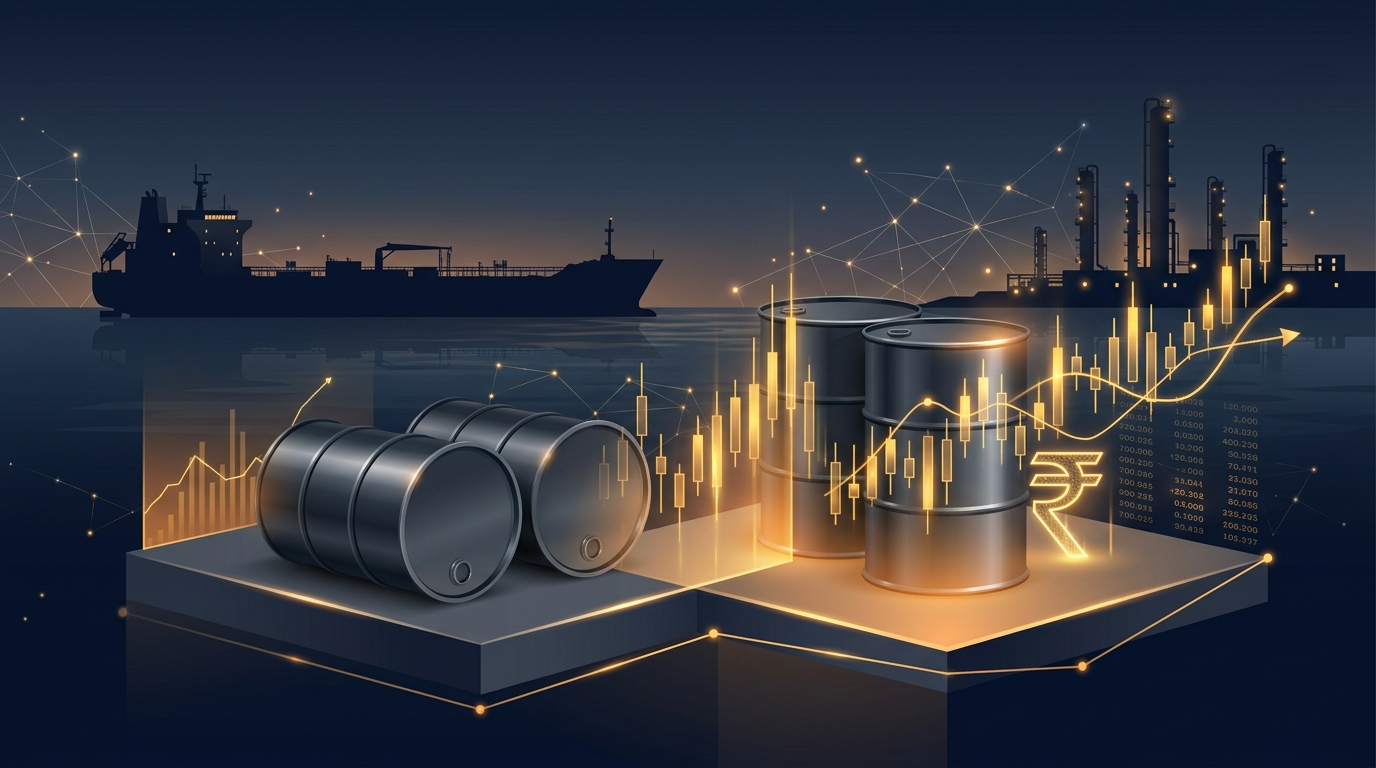
Crude Oil, US Policy and Indian Markets: What Investors Need to Know
crude-oil-price-impact-indian-stock-marketBrent crude futures settled at $109.86 per barrel on October 16, 2026, while US West Texas Intermediate (WTI) crude closed at $101.41 per barrel. The increase reflected concerns over potential supply disruptions linked to geopolitical tensions in the Middle East and damage to Russian energy infrastructure.
Source: Reuters, October 16, 2026 — Oil reaches its highest level since May
At these prices, crude oil is not merely an energy-market concern. For India, it influences import expenditure, inflation, the rupee, interest-rate expectations and corporate profitability.
The US administration's October 16 decision to waive certain provisions of its new Russia-related sanctions and tariff framework offers temporary policy relief to countries importing Russian energy. However, the waiver does not guarantee cheaper crude oil, and other restrictions remain in place.
Source: The White House — Executive Order, October 16, 2026
1. Why Crude Oil Prices Matter to India
India's dependence on imported crude makes its economy sensitive to changes in international oil prices. The Petroleum Planning & Analysis Cell (PPAC), under the Ministry of Petroleum and Natural Gas, publishes official data on crude oil and petroleum-product imports and exports.
Source: Government of India — PPAC Import/Export Data
When crude prices rise, four important economic effects can follow:
Expensive oil increases the cost of India's energy imports, potentially widening the trade deficit and putting pressure on the current account.
Higher dollar demand from importers can put pressure on the domestic currency. A weaker rupee also raises the rupee-denominated cost of imported crude.
Higher fuel, freight and industrial input costs can spread across manufacturing, logistics and consumer goods.
Companies that cannot fully pass on rising costs may experience lower operating margins. The impact varies according to their pricing power, contracts and input mix.
Recent Indian market reporting has highlighted the combination of elevated oil prices, currency pressure and foreign investor outflows as a source of concern for equities.
2. Will the US Waiver Make Russian Oil Cheaper for India?
The US policy change gives refiners greater potential flexibility, but the final economic benefit depends on the delivered cost of Russian crude compared with alternative supplies.
Three critical factors matter:
- Crude discount: Russian oil offers an economic advantage only when its price is sufficiently competitive against alternative grades.
- Shipping and insurance: Freight, insurance and transportation expenses can offset a discount on the oil itself.
- Policy uncertainty: The US administration has retained authority to reconsider the waiver. Secretary of State Marco Rubio said the administration would use a 60-day period to assess the potential implications of further sanctions and tariff action.
Sources: Reuters, October 18, 2026 — US administration's 60-day review | White House executive order
3. Why Global Supply Conditions Still Matter
The Strait of Hormuz is an important route for international oil shipments. Any disruption to shipping through the strait can restrict supply availability, increase freight costs and raise the risk premium embedded in crude prices.
On October 18, Reuters reported that Iran had reiterated a conditional proposal to reopen the strait within seven days, while negotiations with the United States remained unresolved.
Source: Reuters, October 18, 2026 — Iran's proposal to reopen the Strait of Hormuz
For the oil market, the implication is straightforward: a policy change affecting Russian energy purchases cannot independently resolve supply concerns elsewhere.
If shipping conditions improve, additional supply becomes available and crude prices moderate, India could benefit from lower import costs. If disruptions persist, expensive oil could continue to put pressure on the Indian economy despite the US waiver.
4. Indian Stock Market: Which Sectors Could Be Affected?
Crude oil creates different effects across industries. Oil-consuming businesses often face higher costs when prices rise, while upstream oil producers may receive higher revenues. Oil marketing companies sit between these two categories, with profitability determined by fuel pricing, refining economics and inventory movements.
Moneycontrol's coverage of crude-sensitive Indian stocks has documented how sharp increases in oil prices have affected airline, paint, tyre and oil marketing shares, while upstream oil producers can receive support from stronger crude prices.
Oil Marketing Companies: IOC, BPCL and HPCL
Oil marketing companies (OMCs) purchase crude or petroleum products and sell fuels such as petrol and diesel. Their profitability depends on procurement costs, refining margins, retail marketing margins, inventory movements and government policy.
When crude prices rise, input costs and working-capital requirements may increase. If retail prices do not adjust sufficiently, marketing margins may come under pressure. Conversely, lower crude prices can provide relief, although inventory losses on previously purchased oil can offset part of the benefit.
What investors should monitor: Refining margins, marketing margins, fuel-price adjustments, crude procurement costs and inventory effects.
Market implication: Lower crude can be supportive for OMCs under favourable margin conditions, but it is not automatically a bullish signal for every company.
Aviation: IndiGo and SpiceJet
Aviation turbine fuel (ATF) is a major operating expense for airlines. Consequently, changes in oil and jet-fuel prices can significantly influence operating margins.
Lower fuel costs may support profitability if airlines retain a portion of the savings. Higher costs can pressure margins, especially when competition makes fare increases difficult.
What investors should monitor: ATF prices, passenger demand, ticket yields, fuel expenditure and foreign-currency liabilities.
Market implication: A sustained decline in fuel costs could support airline profitability, while persistently expensive oil creates an earnings risk.
Paints: Asian Paints, Berger Paints and Kansai Nerolac
Paint manufacturers use various petrochemical-derived inputs, solvents, chemicals and packaging materials.
Lower prices for relevant raw materials may reduce costs over time. However, the actual benefit depends on purchasing contracts, inventory cycles, product mix and competition.
What investors should monitor: Gross margins, raw-material prices, volume growth and management commentary.
Market implication: Sustained input-cost relief may support margins, but the relationship between crude prices and paint earnings is neither immediate nor uniform.
Tyres: MRF, Apollo Tyres and CEAT
Tyre manufacturers use synthetic rubber, carbon black and other petroleum-linked materials alongside natural rubber and additional industrial inputs.
Some input costs may rise when crude prices increase and decline when oil becomes cheaper. Natural rubber prices, currency movements, freight costs and vehicle demand also influence profitability.
What investors should monitor: Raw-material costs, pricing trends, demand and operating margins.
Market implication: Lower oil prices can provide cost relief for selected inputs, but they do not guarantee stronger earnings across the tyre sector.
Chemicals and Petrochemicals: Reliance Industries and Other Producers
Crude oil affects feedstock costs, product prices and refinery economics. The outcome depends on the difference between a company's input costs and the prices it receives for finished products.
Lower crude may benefit certain feedstock buyers, while integrated refiners and petrochemical producers may experience inventory losses or weaker realisations during a sharp price decline.
What investors should monitor: Refining margins, petrochemical spreads, feedstock costs, capacity utilisation and inventory effects.
Market implication: Product spreads and business mix are more informative than crude prices alone.
Oil Exploration: ONGC and Oil India
Upstream producers can benefit from higher realised crude prices, subject to production volumes, operating costs, domestic pricing arrangements and applicable policies.
The relationship differs from that of oil marketing companies, which may face cost pressure when they cannot pass higher procurement costs through to selling prices.
What investors should monitor: Realised crude prices, production volumes, costs and government pricing policies.
Market implication: Higher crude can support upstream revenue, while a sustained decline can reduce it. Company-specific factors remain important.
Logistics and FMCG
Fuel is an important expense for transportation and distribution businesses. Crude-linked materials also affect certain consumer-goods packaging and manufacturing costs.
Lower fuel prices can reduce some transportation expenses, while higher prices may lead to increased freight charges. The impact depends on contracts, competition and the ability to pass costs to customers.
What investors should monitor: Freight expenses, packaging costs, operating margins and consumer demand.
Market implication: Sustained energy-cost relief may support selected logistics and consumer-goods businesses, but the benefit varies by company.
5. Sector Impact at a Glance
| Sector | Potential benefit from sustained lower crude | Risk if crude remains elevated |
|---|---|---|
| Oil marketing companies | Improved margins under favourable pricing conditions | Higher input costs and potential margin pressure |
| Aviation | Lower fuel expenses | Higher ATF costs |
| Paints | Relief in selected raw materials | Input-cost inflation |
| Tyres | Lower costs for some synthetic inputs | Higher synthetic-material and freight costs |
| Chemicals and petrochemicals | Potential feedstock savings | Unfavourable product spreads or inventory effects |
| Oil exploration | May benefit less from lower realised prices | Potential revenue support from higher prices |
| Logistics | Lower fuel expenditure | Higher transport costs |
| FMCG | Potential packaging and freight savings | Pressure on manufacturing and distribution costs |
Source note: Sector relationships are directional and depend on business-specific costs and market conditions. See Moneycontrol's analysis of crude-sensitive Indian stocks.
6. What Does This Mean for Global Markets?
The global effects of crude prices depend on whether an economy imports or exports substantial quantities of oil.
- Oil-importing countries: Lower prices can reduce import expenditure, ease inflation and lower the operating costs of energy-intensive businesses.
- Oil-exporting countries: Higher prices can support export receipts, while a prolonged decline can put pressure on government revenue and investment.
- Global manufacturing: Petrochemicals, transportation and industrial supply chains are exposed to oil-linked costs. The benefits of lower prices depend on how quickly input prices adjust relative to selling prices.
- Consumers and central banks: Expensive energy reduces household purchasing power and can complicate inflation management. Persistent inflationary pressure may affect interest-rate expectations and financial-market valuations.
For Russia, a broader range of potential buyers may support export opportunities, subject to discounts and remaining restrictions. For the US and other importing economies, lower fuel prices can help consumers, while some energy producers may see weaker revenue.
7. Three Scenarios Investors Should Watch
To navigate market volatility, market participants should assess three conditional macroeconomic scenarios:
Crude Prices Decline
If shipping risks ease and global supply improves, India could benefit from a lower import bill and reduced inflationary pressure. Aviation, selected manufacturers, logistics businesses and some consumer-goods companies may see cost relief.
OMC profitability would still depend on marketing margins, fuel pricing and inventory movements.
Crude Remains Above $100 / bbl
If supply risks persist and oil remains elevated, the benefit of the US waiver may be insufficient to offset the higher cost of energy imports.
Import expenditure, currency pressure and input-cost inflation could remain ongoing concerns for the Indian economy.
Crude Prices Rise Further
A further increase could intensify pressure on the import bill, the rupee and corporate margins.
Upstream oil companies may benefit from higher realised prices, while fuel-intensive businesses may face additional cost pressure.
Note: These are conditional analytical scenarios, not predictive forecasts of future oil prices or individual stock returns.
8. Economic Indicators to Monitor
Before drawing investment conclusions about the market impact, investors should track these seven core macro checkpoints:
- Brent crude and the Indian crude basket: Whether prices remain elevated or decline over several consecutive trading sessions.
- Russian crude discounts and supply: Whether the delivered cost to Indian refiners is competitive with alternative West Asian and Atlantic grades.
- The Strait of Hormuz: Whether physical shipping conditions, insurance rates, and tanker transit throughput improve.
- The rupee against the US dollar: Whether currency movements amplify or offset fluctuations in international crude prices.
- Inflation and the import bill: Whether energy costs are feeding into broader CPI/WPI prints and the trade deficit.
- Corporate earnings: Whether quarterly results reflect actual margin compression, inventory gains/losses, or pricing power pass-through.
- US policy updates: Whether the 60-day waiver remains in force, is expanded, or faces fresh regulatory tightening.
Official import and export figures can be checked through the Petroleum Planning & Analysis Cell (PPAC), while the policy position should be verified against the White House executive order.
IPOChacha Market View & Key Takeaways
The US waiver provides temporary relief from certain tariff and sanctions provisions linked to Russian energy purchases. However, the direction of crude prices will continue to depend on physical supply, shipping conditions, geopolitical risks and the price at which refiners can secure alternative supplies.
For India, sustained lower crude prices would generally ease import expenditure and provide relief from some inflationary pressures. Persistently expensive oil could have the opposite effect, placing pressure on the rupee, input costs and corporate margins.
At the sector level, aviation and selected manufacturers are sensitive to energy costs; OMCs require a closer assessment of marketing margins and inventory effects; upstream producers may benefit from stronger realised prices; and petrochemical companies must be assessed through their product spreads.
Recommended Market Reading

Practical SIP Strategies: How to Choose a Plan, Optimize Contributions & Build Lasting Wealth
Scheme selection frameworks, goal horizon matching, the 10% Step-Up accelerator, mutual funds vs. stocks, and an 8-step roadmap for smart execution.

The Miracle of SIP: Can ₹1,000 a Month Build Real Wealth?
How systematic investing works, what historical Nifty 50 market data reveals, compounding simulations, and why starting early beats waiting for ideal market conditions.

Jio Platforms IPO 2026: Price, Dates, Financials, Valuation and Should You Apply?
Reliance Industries' digital behemoth, Jio Platforms Limited, is preparing to launch India's largest-ever IPO worth up to ₹30,213 crore. Explore dates, price band, FY24–FY26 financials, valuation, use of proceeds and key risks.